Is Your Shot In or Out? Check the Disc Golf Rule Book!
In a world where disc golf enthusiasts are united by their passion for the sport, there’s one common pet peeve that tends to irk them: the misnomer “frisbee golf.” To clarify, disc golf is a distinct and rapidly growing sport that involves throwing a specialized disc towards a target known as a “basket.” While it might seem trivial to some, the distinction is vital to those who are committed to the game. So before we delve into the nitty-gritty of the rules governing whether a shot is in or out of the basket, let’s set the record straight: it’s disc golf, not frisbee golf.
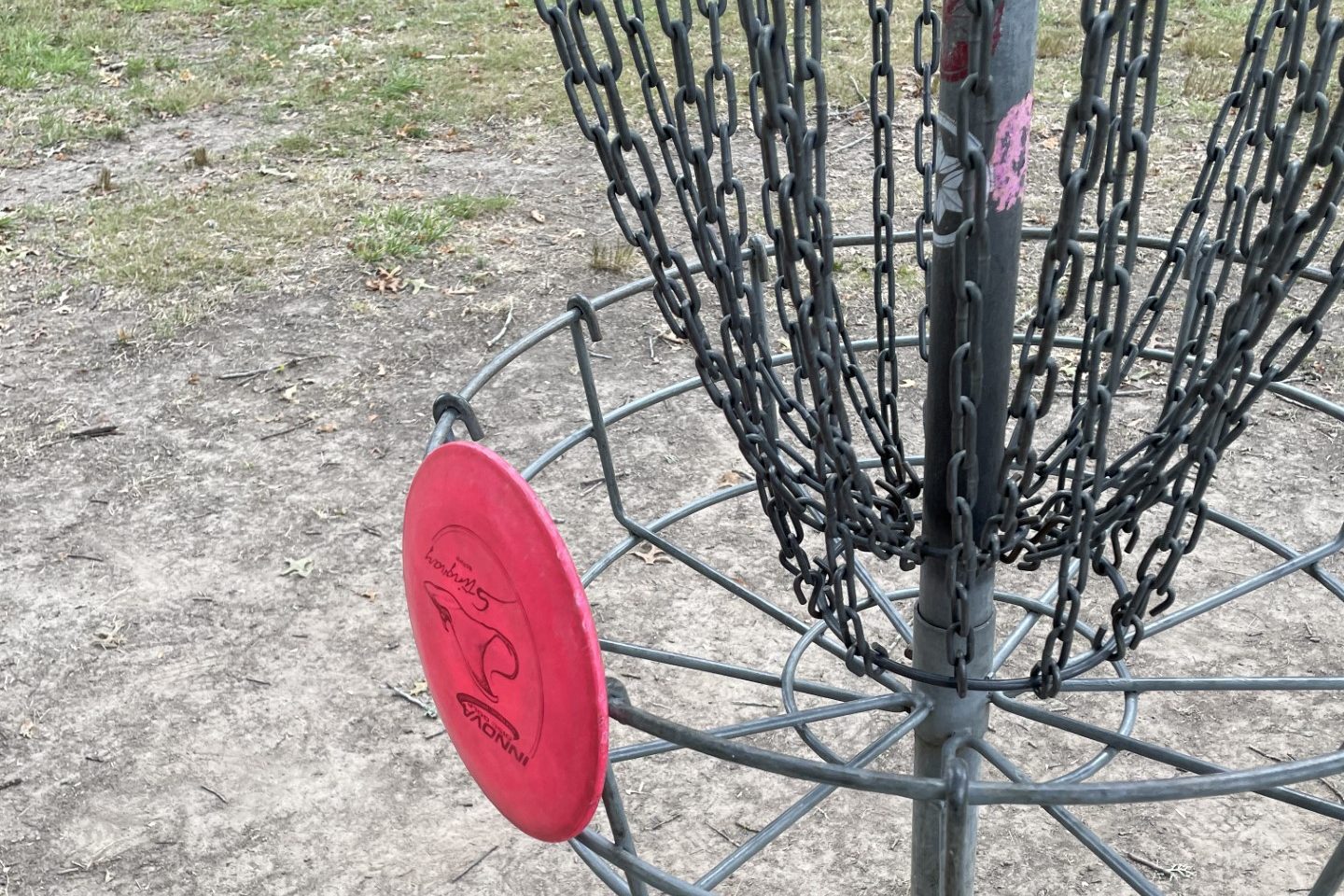
Now, let’s get down to the nitty-gritty of the rules surrounding the defining moment in disc golf – the “in or out” call when it comes to the basket. The article photo is a real-life result of my putt on hole 8, today. Is it “in” or “out”?
To score a point, or in the parlance of disc golf, to complete a hole, a player must successfully complete a throw that lands their disc in the basket in as few throws as possible. But how do we determine if a shot is in or out? Here are the key rules as outlined in the PDGA (Professional Disc Golf Association) rule book, specifically in Section 807 “Completing the Hole”:
- Basket Completion: For a throw to be considered successful and count as a point, the disc must come to rest inside the target basket. This means that merely hitting the chains or the outer cage does not count – the disc must be fully contained within the basket to be considered “in.”
- In the Chains: The chains are often the most critical part of the basket as they are designed to help guide the disc into the basket. If your disc lands in the chains and then settles into the basket, it’s still considered “in.”
- Spit Outs: Sometimes, the disc may momentarily settle in the basket but then unexpectedly fall out. In most cases, this is still counted as a successful throw, as long as it was initially inside the basket. This can be a source of controversy, but the general rule is to give the player the benefit of the doubt if the disc appeared to have “caught” in the basket before falling out.
- Out of Bounds: If your disc lands outside the defined boundaries of the course or is caught in an obstruction, it’s considered “out.” You’ll need to take a penalty stroke and throw from a designated drop zone or where the disc went out of bounds.
- Optional Re-throw: If you’re unsure whether your shot was in or out, or if it’s hanging precariously on the edge of the basket, you have the option to take a re-throw. This can help eliminate any ambiguity and ensure a fair outcome.
In conclusion, while the debate over calling disc golf “frisbee golf” may rage on, there’s no disputing the importance of understanding the rules that govern this exciting sport. So, the next time you’re out on the disc golf course, remember that the key to success lies in making sure your shots land “in” the basket, not merely hitting the chains. Happy disc golfing! For further details, you can always refer to Section 807 of the PDGA rule book for a comprehensive guide to completing the hole in disc golf.